
The Evolution of Hmong Dance: My Journey and the Future Ahead
- Metta Xiong
- Nov 12, 2025
- 10 min read

Hello!
Hmong dance has evolved significantly from its early days to what we see on stage today. This shift has sparked many discussions and even debates between different generations of dancers. While some of these conversations may have rubbed people the wrong way, I find myself agreeing with parts of what’s being expressed.
This past year, several annual dance competitions have faced issues ranging from disorganization to unfair judging and even blatant disrespect toward dancers. Earlier this year, I shared my thoughts on how Hmong dance is changing and why it’s time for organizers to acknowledge and adapt to this evolution. Before diving deeper into my opinions on the current state of Hmong dance, I want to take a step back and reflect on my own dance journey and share the evolution of the Hmong dance community into what it is today.
Hmong Dance in the 90's
My connection to Hmong dance began at the age of five, in 1998. Before I ever stepped into a dance class, my only exposure to the art form was at Hmong New Year celebrations, particularly in Merced. This was before organized dance competitions became popular in the late 90s. Back then, Hmong dance was primarily seen as a filler performance on the main stage, or showcased on smaller, outdoor stages where anyone could share their talents. Hmong dance, initially influenced by Lao and Thai cultures, evolved into a unique expression of our own identity. Old YouTube videos from the 90s offer a glimpse into these early forms; traditional Hmong clothing paired with the limited Hmong music available at the time. Traditionally, Hmong dance was interwoven with live music from the qeej and other instruments, fostering creativity and intentionality in choreography. In those early days, before YouTube and other readily available music, artists like Paradise and Destiny were rising to popularity, singing beautiful ballads that were perfect for singing along to, but not exactly danceable. We primarily relied on cassette tapes with CDs only just beginning to emerge in the early 2000s.

When my sister, Mimi, started teaching dance, finding inspiration for both music and costumes was a real challenge. I remember vividly searching for music video DVDs at New Year celebrations or swap meets. If Mimi found a song she loved and wanted to choreograph to, she would record it onto a cassette tape. Think of it like listening to a song on YouTube and then recording it with your phone so you can play it back later to practice your dance routine; that was our music acquisition system! The early 2000s also marked a shift away from traditional Hmong clothing for performances. With limited access to vendors and no easy way to buy costumes, we had to create everything by hand. My mom was our primary seamstress, but all the dance moms pitched in, piecing together our outfits and props. It was a true DIY era, forcing us to become incredibly creative with our designs and materials.

Hmong Dance in the 2000's
As dancers in Central California, we had the opportunity to compete against many talented groups such as, Nkauj Hmoob Looj Ceeb, Ntxhais Yaj Yuam, Nkauj Tshiab Liag, and Nkauj Hmoob Xob Laim, to name just a few. We were all accustomed to a particular style of dancing, a blend of traditional elements with a more modern flair. Competitions were the highlight of our year, and we tried to participate in as many as possible in our area, including Merced, Fresno, and even Stockton for a few years. One year, we decided to compete in Chico, as it was the last year for many of us before moving on to new chapters in our lives. The vibe at this competition was distinctly different and so was the style of dance. While we were used to a more traditional approach, the dancers in Chico showcased a powerful, energetic style we are more familiar with today. It was this experience that truly made me realize that Hmong dance is truly evolving.

This period also marked the introduction of Chinese-acrobatic influences into Hmong dance, particularly from groups in the Midwest. I vividly recall the first time a group came to compete in Fresno. It was Minnesota Sunshine in 2003-2004, and their unique style was unlike anything we had seen before in California. They ended up taking first place, and the following year, two more groups with a similar style swept the competition, claiming the top three spots. This caused a significant divide in the California Hmong dance community. Many felt that this style wasn't truly "Hmong dance," and their outrage was understandable. The competition organizers responded by requiring a traditional Hmong dance round and a freestyle round, but the damage had already been done. Participation dwindled, leading to a decline in Hmong dance within California. Competitions that once boasted 10-15 groups were reduced to just five or fewer by the 2010s. The pioneers of Hmong dance were growing up, pursuing higher education, starting families, and moving on with their lives. What began as a passionate hobby was unintentionally leading to a discontinuation of cultural preservation.
My Last Competition
2009 marked my final year as an official dancer. With a fresh wave of new members, we poured our energy into creating routines that blended modern energy with that classic traditional feel. With the changing landscape, our aim was to compete in only Merced and the final year arrived faster than we thought. After more than a decade of dancing, I was ready to focus on new chapters in my life. As we took the stage that year, I felt a profound sense of peace, knowing it was coming full circle and ending a chapter I had long grew up with. Standing beside me were some of the girls who had been there since the beginning, a perfect way to finish strong. Then, the unexpected happened, we placed first in our very last competition! "Shocked" doesn't even begin to describe it. The best part is, my dad was so unconcerned he didn't even film the announcements, he ended up pointing the camera at us and we were chatting amongst each other, unaware of the outcome. Then our name was called and, in disbelief, we sat up with shock. It's a moment forever seared into my memory. It was a great moment for all of us and it truly felt as if we had gone out on top, on our terms. If I ever find that video clip, I'll have to share that with all of you.

My Other Dance Involvement & Circling Back to Hmong Dance
Leaving Hmong dance allowed me to explore other dance styles and hone my skills. I dove into jazz, hip hop, and cheerleading, all driven for a love of performing. Cheerleading felt like a natural fit, and the challenge of learning new skills and stunts kept me engaged. I'm grateful for the opportunities to cheer in high school and college, and to later coach middle school students and competition teams. These experiences sharpened my eye for detail and expanded my knowledge of movement and technique. When I competed for my Miss Hmong titles in 2010 and 2013, dance was the obvious choice for my talent. Over the last decade, I've also been honored to be asked to return to the Hmong dance world as a judge, class host, and teacher, contributing my expertise to dancers reconnecting with our culture.
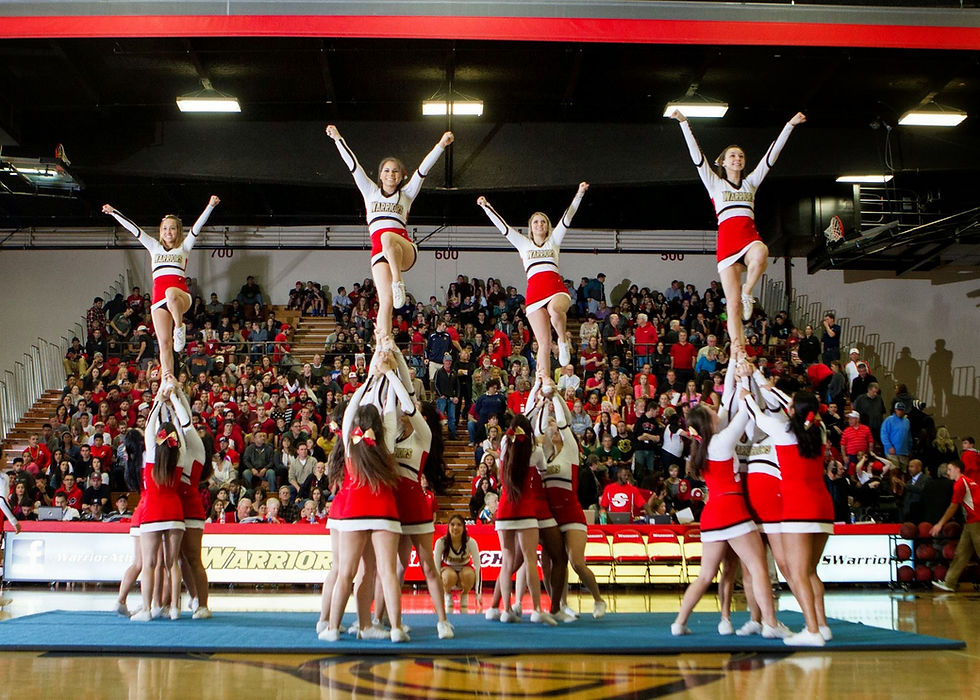
Following that period of decline, Hmong dance experienced a remarkable resurgence. Suddenly, there was an influx of dancers, sparking interest among young girls who idolized the art form. This led to the creation of junior and senior dance categories, opening up new levels of competition. This increased popularity has made dance one of the main attractions at Hmong New Year celebrations, drawing hundreds of spectators to support their loved ones on stage. As I've mentioned in my Facebook Post last December, it's time for a shift in how organizers approach Hmong dance competitions.
Understanding the Challenges
While I'm eager to move forward with my vision and advocate for positive change in the Hmong dance community, one major issue needs to be addressed: the scoring systems at dance competitions. The rubrics I've encountered often lack clear guidelines, making them highly subjective. This contrasts sharply with Americanized dance and cheer competitions, where technique is heavily emphasized (30-40% of the score), and other criteria like choreography, performance, showmanship, and difficulty level are clearly defined. The inconsistent and individualized rubrics used by different Hmong dance competition hosts create confusion and hinder teams' ability to prepare effectively. When I competed in cheer and dance, we knew exactly what judges were looking for. Without that clarity, teams are set up to fail, and that's something I'm determined to change.
Moving forward, our primary goal should be to create a scoring system that is as objective as possible. All feedback provided must be clear, concise, and actionable to eliminate confusion and questions. Judges must also be committed to fairness, providing scores based solely on the dance performance to prevent any biases from influencing their assessments. To ensure the integrity of the scoring process, judges' scores for each team should be roughly similar. Significant disparities in scores suggest inconsistencies in evaluation and raise concerns about objectivity. Last year, a significant scoring discrepancy arose, prompting legitimate questions and concerns from one of the competing dance groups. Another major concern is the issue of conflicts of interest. The Hmong community is relatively small, and the dance community is even smaller. When someone who is both skilled and deeply involved in the community is chosen to score or judge competitions, it can easily lead to gossip, speculation, and concerns among different teams.
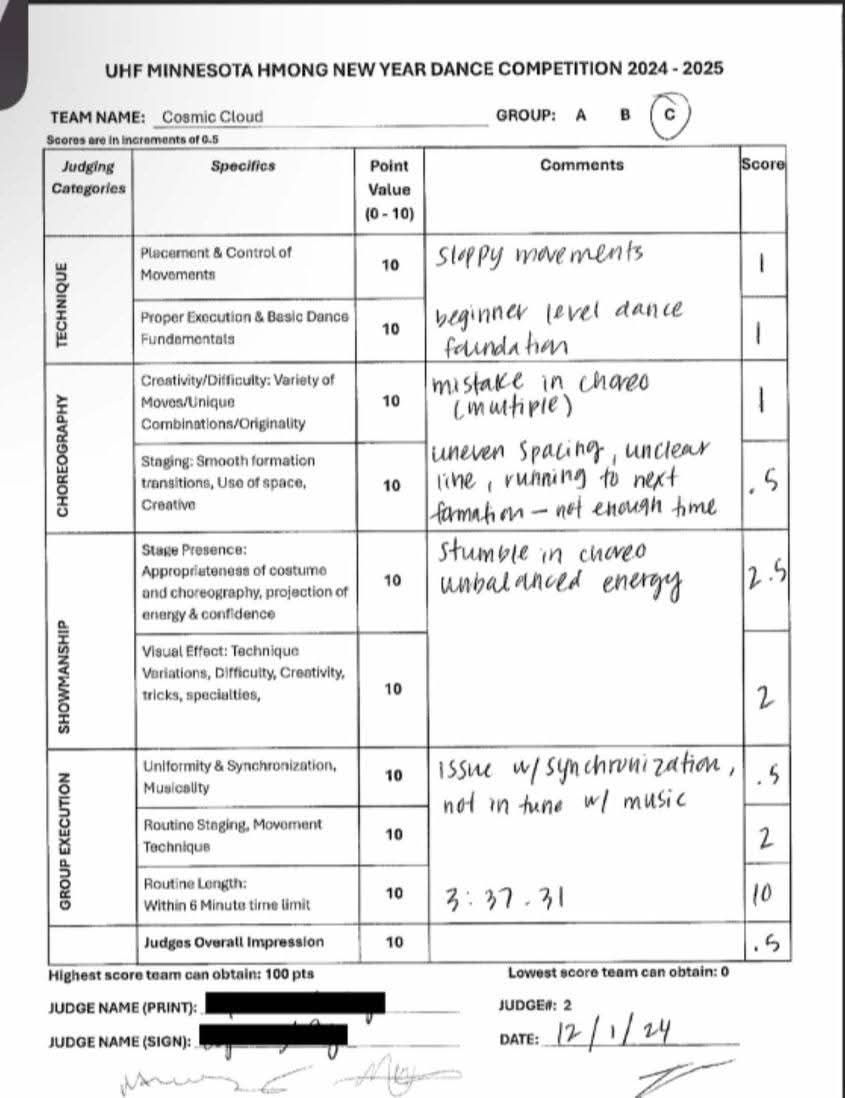

I went and watched both performances from this group since I'm not sure which performance this score sheet came from, and here are my thoughts and feedback that I would have provided if I were judging this competition:
Technique: Work on technique and fundamentals (arm extension, hand flexibilities). Work on clean transitions and synchronization; clean lines will result in a clean performance
Choreography: Great choreography, however, low execution. Work on simplifying the dance to ensure all members can execute the dance move. By having higher difficulty level of dance moves dancers are not ready for, it will result in low execution. Wonderful transitions and great use of space, again, work on synchronization to have clean transitions.
Showmanship: Beautiful outfits. Work on facials as smiles start to falter. Low stamina towards the end of the performance begins to become apparent. Continue to carry the same energy from start to end.
Group Execution: Great music. Work on synchronization in all parts of the dance from start to end; arm movements, transitions, level changes, etc. The choreography is great, however, work on being a team when competing. When one performer is off, the whole team and routine is off. When all dancers can dance together, the dance will show it's greatest potential.
As a judge, many dance teams each year often get similar notes from me. I do my best to be clear on what can be improved. Since I wasn't sure which dance this score sheet came from, I kept it more general as these were some of the things I saw in both of the group's performances that can be improved on.
The Controversial TikTok Video by Belinda Kalia
There was a video that circulated on TikTok addressing how Hmong dance has evolved into what it is today. While the creator’s delivery offended many in the dance community, I don’t believe her intention was to attack any one individual. I am not defending her approach, but I do understand the core message she was trying to share. I agree that Hmong dance has changed over time, and in some areas it has become excessive or even overly sexualized. Similar movements often appear across multiple teams, which can create a sense of repetition. In her video, she mentioned the “stomping” style of dance. I see the point she was trying to make, but I think many current dancers may not fully understand her perspective, since this is the style they’ve grown up learning from the start. I also believe there are some fundamental techniques and basics that are being overlooked or not consistently taught. Dancers with technical training often notice these gaps. With so much focus now on fast-paced choreography to convey excitement and high energy, the foundations are sometimes skipped. It’s almost like asking someone to run before they’ve learned how to walk, having a sickled foot, or being able to execute a backhand spring with poor technique.
Traditions in Motion Event (TIME) Hmong Dance Competition
When this event first announced their competition, I was extremely excited about it. An event without ties to Hmong New Years and solely focused on the dancers. This is an event hosted by Jada Her (Founder of TIME, Miss Hmong California 1st runner up, & Miss Asian Global 3rd Princess). Her ties to the Hmong dance community runs deep as her sisters and family members are previous members of Hmong dance teams.
I had the honor of serving as one of the judges for this competition and was completely blown away by all the talent that I saw. It made me excited to know that there are so many young girls out there who have such a passion for dancing and performing.
First and foremost, I would like to acknowledge and applaud Jada for her courage and advocacy for Hmong dance and in recognizing the need in this area. I will continue to support her vision for the success of TIME and wish nothing but growth and success for her goals! This year marks 50 years that Hmong people have lived in the United States so being able to accomplish a vision that is revolutionary to not only the Hmong community but the Hmong dance community.

Next, congratulations to all of the competing teams as you are all the first to make history with TIME! All of the groups were so entertaining to watch and it was such an honor to judge the senior team. Here are the results from the competition:
Senior Division
1st: Serene Suns (DLDS)
2nd: Viv Ncaus Koom Siab (HCAP)
3rd: Ntxhais Tshaj Koob
Junior Division
1st: Ntxhais Yeeb Suab (MSDI)
2nd: Nkauj Yub Nag (HCAP)
3rd: Ci Li Ntuj (HCAP)
Event Photographer: Kom Takes Pictures
Event Videographer: Vision by Saen
The Future of Hmong Dance
I’ve recently seen more voices in the Hmong dance community call for competitions that take place outside of Hmong New Year events, and I couldn’t agree more. Expanding opportunities for dancers throughout the year would not only strengthen our community, but also enhance performance experience, foster continuous growth, and encourage teams to further develop their mindset and artistry.
My hope is that dancers can build confidence, connect with one another, and genuinely enjoy the art of dance together, united, rather than divided by competition. We’ve all seen how toxic environments can take away from the beauty of what we do. The future of Hmong dance is incredibly bright. The talent is already here. With the right leadership, passionate contributors, and a shared mission and vision, we have the potential to create a thriving and uplifting foundation for generations of dancers to come.
Xx
Metta Xiong


thank you for sharing this<3 As a coach who has minimal Hmong dance experiences, this has encouraged me in so many ways. My whole life I've only hip hop and dipped into cheer and jazz here and there. Then one day a team needed a leader and i was the only one who was best fit. Now here i am lol I love the process of the choreo and the outfit designs but yes I agree that it can be super hard to know what exactly are the criterias are with judges. But like I always tell my team, the scores do not measure your value. But your dedication and hard work should.